
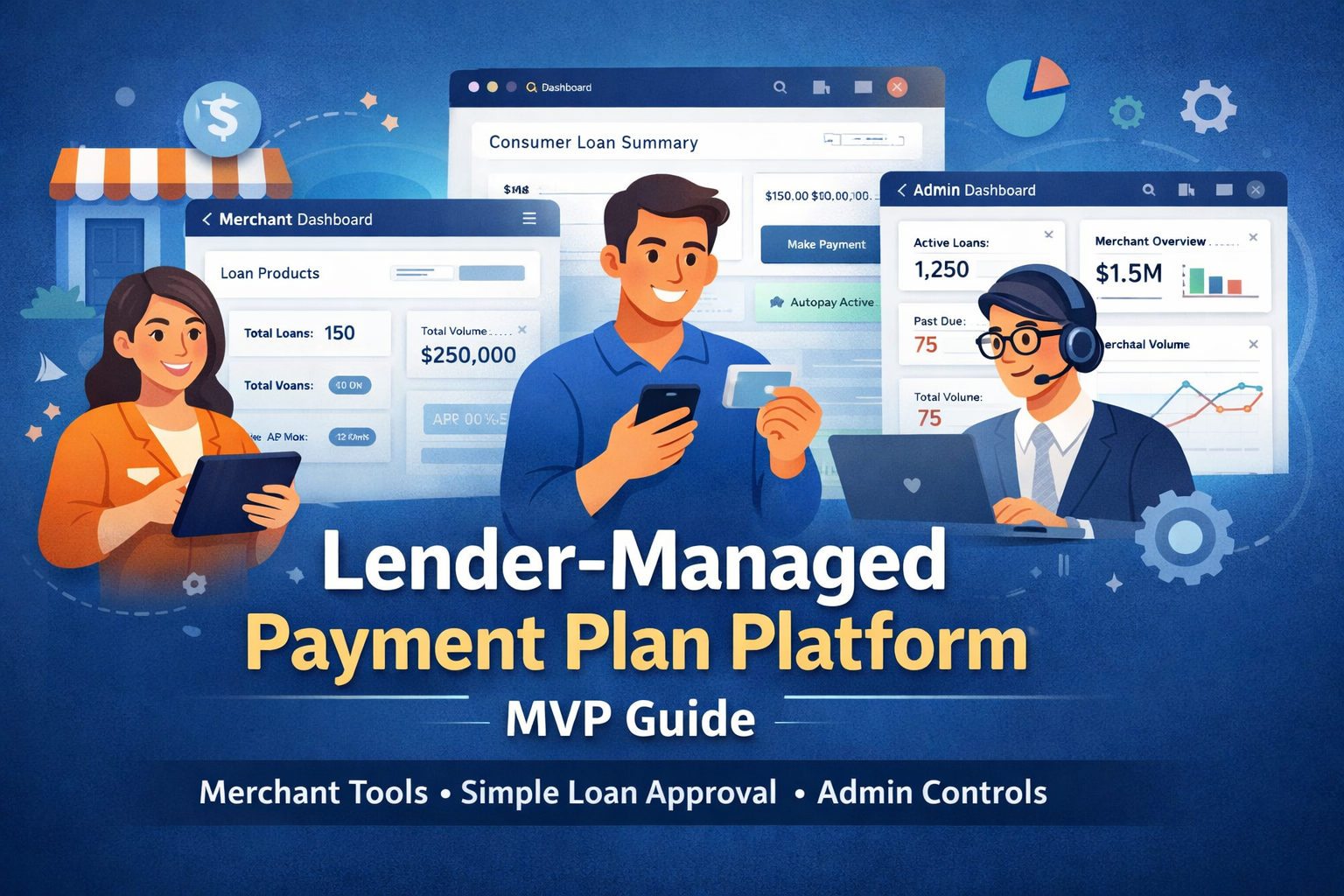
Financing has become a powerful growth lever for businesses. When customers can pay over time instead of upfront, conversion rates increase, average order values rise, and merchants unlock new revenue streams.
A Lender-Managed Payment Plan Platform enables merchants to offer structured financing to consumers while lenders maintain control over billing, servicing, and loan management.
In this blog, we break down how an MVP (Minimum Viable Product) of such a platform can be designed—focusing on simplicity, scalability, and a strong foundation for future fintech features.
What Is a Lender-Managed Payment Plan Platform?
A lender-managed payment plan platform allows merchants to offer financing directly to their customers without managing lending operations themselves.
The platform handles:
• Loan applications
• Consumer onboarding
• Payment collection
• Loan servicing
• Merchant performance reporting
This approach allows lenders to control compliance, risk management, and payment processing while giving merchants simple tools to offer financing.
Why Businesses Are Moving Toward Merchant Financing
Merchants increasingly adopt payment plans because they:
• Increase conversion rates
• Enable customers to afford higher-value purchases
• Improve customer retention
• Provide predictable recurring revenue
Meanwhile, lenders gain a scalable way to distribute financial products through merchant networks.
This model powers many modern fintech platforms across industries like healthcare, home services, retail, and education.
Coder Scotch provides end-to-end development from concept to launch.
👉 Talk to our fintech development team today.
MVP User Types
The MVP focuses on three primary user groups to keep the system simple and test the core financial workflows.
1. Merchant (Primary External User)
Merchants act as distribution partners for loan products.
Key capabilities include:
• Creating loan products
• Generating application links
• Monitoring financing performance
Merchants do not manage loans directly—they simply offer financing to customers through the platform.
2. Consumer (Borrower)
Consumers are the borrowers applying for financing.
Their journey includes:
• Applying for a payment plan
• Reviewing loan offers
• Accepting terms
• Setting up payment methods
• Managing loan payments
The experience must be extremely simple to maximize application completion rates.
3. Admin (Internal Operations)
Admins manage the system internally.
They handle:
• Monitoring merchants
• Reviewing loans
• Handling payment exceptions
• Performing manual overrides
This ensures the platform can operate efficiently even without full automation in the MVP.
Core Product Modules (MVP)
To launch quickly and validate the product, the MVP focuses only on the essential modules.
1. Merchant Dashboard
Purpose: Allow merchants to create and distribute financing options.
Features include:
• Secure authentication
• Loan product creation
• Application link generation
• High-level performance analytics
Merchants can configure loan products with:
• Fixed price
• Multiple terms (6, 12, 24, 36, 48 months)
• APR options (0%, 11.99%, 14.99%, 24.99%)
• Optional down payment
• Active/inactive product status
Each product generates a unique loan application link that merchants can share with customers.
2. Consumer Application Flow (4 Steps)
A smooth application flow is critical for conversion.
The application process is designed to be extremely simple.
Step 1: Basic Information
Customer provides:
• Name
• Email
• Phone number
Step 2: Identity & Financial Information
Customer submits:
• Address
• Date of birth
• Last 4 digits of SSN
Step 3: Review Offer
Customer reviews:
• Loan amount
• Payment schedule
• Interest rate
• Monthly payment
They then accept the terms and provide a digital signature.
Step 4: Payment Method
Customer adds a payment method:
• Debit card
• Credit card
• Bank account
Autopay is required to reduce missed payments.
MVP Approval Logic
To test the product experience, the MVP uses simple approval logic.
Everyone is approved.
No credit decisioning
No declines
No underwriting rules
This allows the platform to focus on testing:
• UX
• Loan servicing
• Payment processing
• Reporting accuracy
Consumer Dashboard
Once approved, borrowers gain access to a simple dashboard.
The dashboard includes:
• Loan balance
• Next payment date
• Payment amount
Consumers can also:
• Make manual payments
• View loan details
• Manage autopay
• Review payment history
• See payoff options
The goal is to provide a clear and frictionless loan management experience.
Admin Dashboard
Admins require visibility and control over the entire platform.
Admin capabilities include:
• Viewing merchants
• Monitoring consumers
• Managing loans
• Reviewing payment history
Admins can also perform manual actions such as:
• Marking payments as paid
• Pausing loans
• Canceling loans
Automation rules are intentionally excluded from the MVP to keep the system simple.
Billing & Payment Processing
The platform supports monthly billing only in the MVP.
Core payment capabilities include:
• Monthly interest accrual
• Autopay billing
• Tokenized payment storage
Payment processing is handled through secure providers such as:
• Stripe
• Authorize.Net
• NMI
PCI compliance is handled by the payment processor.
Simplified Data Model
The platform is built around five core entities.
These act as the single source of truth for the system.
• Merchant
• Loan Product
• Consumer
• Loan
• Payment
All reporting and analytics derive from these core tables.
Hard-coded metrics are avoided to ensure scalability and accuracy.
Reporting (MVP)
The MVP includes simple but useful reporting.
Merchant Reporting
Merchants can view:
• Total loan volume
• Active loans
• Payments collected
Admin Reporting
Admins see the same metrics across all merchants, allowing them to track platform performance globally.
What Is Deliberately Out of Scope (MVP)
To prevent scope creep and accelerate launch, several features are intentionally excluded.
These include:
• Credit underwriting
• Risk tiering
• Merchant payout logic
• BNPL integrations
• Accounting exports
• Affiliate tracking
• SMS or email automation
• Multi-currency support
• Legal document generation
These can be introduced in future phases once the core platform is validated.
Future Expansion: External Credit Decisions
In later phases, credit decisions can be integrated via external APIs such as HighSale.
This will introduce:
• A/B/C/D credit ratings
• Underwriting decisions
• Risk-based loan offers
Although this logic is not implemented in the MVP, the platform architecture must remain flexible enough to support it later.
Why Start with an MVP
Launching a fintech platform is complex. By focusing on a carefully scoped MVP, teams can:
• Validate the product with real users
• Test billing and servicing workflows
• Identify UX improvements
• Reduce development risk
Once the core system proves reliable, advanced features like underwriting, automation, and integrations can be added.
Building Scalable Fintech Platforms
At Coder Scotch, we help startups and financial institutions design and build secure, scalable fintech platforms—from MVP to full-scale lending ecosystems.
Whether you’re launching a payment plan product, lending platform, or fintech marketplace, the right architecture from day one makes all the difference.
Ready to Build Your Fintech Platform?
If you’re planning to launch a digital lending platform, payment plan solution, or fintech MVP, our team can help you design, build, and scale it efficiently.
👉 Contact us to discuss your project and turn your fintech idea into a production-ready platform.
