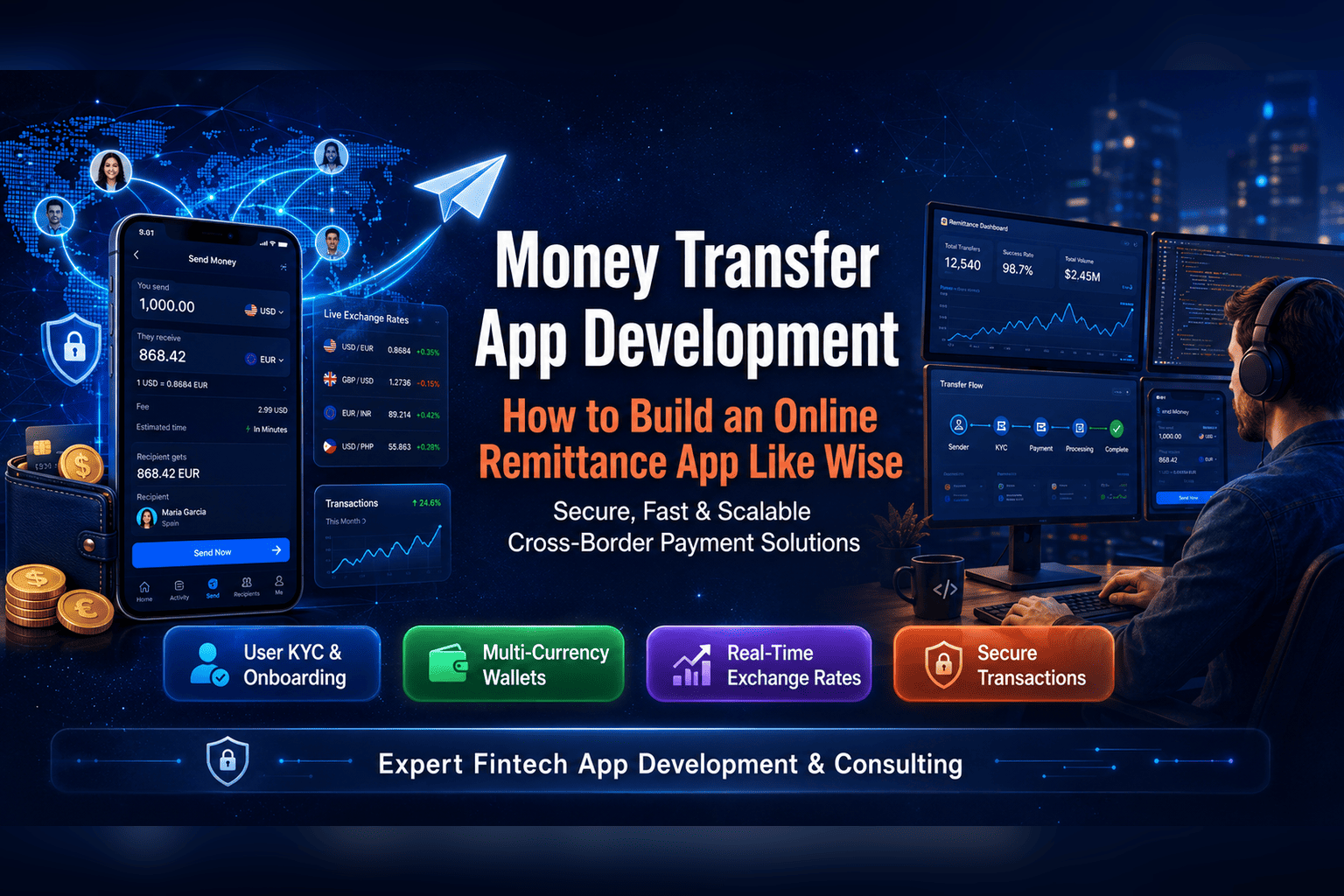
Building an online remittance app like Wise is not just about creating a mobile app where users enter an amount and send money. A real money transfer platform needs a secure transaction engine, currency conversion, KYC and AML checks, payment partner integrations, audit logs, compliance workflows, fraud monitoring, and a reliable backend that can handle money movement without errors.
Wise became popular because it solved three major problems in international money transfers: high fees, unclear exchange rates, and slow bank transfers. According to Wise’s FY2026 results, Wise supported nearly 19 million people and businesses and processed more than $243 billion in cross-border volume. Wise also allows users and businesses to hold 40+ currencies, move money between countries, and spend abroad.
The opportunity is still growing. The global digital remittance market was valued at USD 27.7 billion in 2025 and is projected to reach USD 108.5 billion by 2033. At the same time, sending remittances globally still costs an average of 6.36% of the amount sent, according to the World Bank’s Remittance Prices Worldwide data. This creates space for new fintech products that offer faster, cheaper, and more transparent cross-border payments.
But from a developer’s point of view, building a money transfer app like Wise requires much more than frontend screens. The most important work happens in the backend architecture.
What Is an Online Remittance App?
An online remittance app allows users to send money from one country to another using a mobile app or web platform. The sender can fund the transfer using a bank account, debit card, credit card, wallet balance, or local payment method. The receiver gets money through a bank deposit, wallet, card, cash pickup partner, or local payout rail.
A typical remittance app includes:
- User onboarding
- KYC verification
- Sender and recipient management
- Exchange rate calculation
- Fee calculation
- Transfer creation
- Payment collection
- Payout processing
- Transaction tracking
- Notifications
- Admin review
- AML and fraud monitoring
- Reconciliation and reporting
For a simple app, this may look straightforward. But once you support multiple countries, currencies, payment methods, and compliance rules, the system becomes complex very quickly.
Looking for Expert Fintech Developers?
Our team specializes in building highly secure, compliant, and scalable remittance platforms from scratch. Let’s bring your fintech vision to life.
Core Features of a Money Transfer App Like Wise
1. User Registration and KYC
The first step is user onboarding. Users should be able to sign up using email, phone number, or social login. But for a remittance app, normal registration is not enough. You need KYC verification.
KYC usually includes: Personal details, Date of birth, Address, Government ID upload, Selfie or liveness check, Proof of address, Sanctions screening, Risk scoring.
For development, it is better to integrate third-party KYC providers instead of building everything manually. Providers like Sumsub, Onfido, Veriff, Persona, Trulioo, or local KYC vendors can help verify identity documents and screen users.
The backend should store KYC status separately from the user profile: Pending, Verified, Rejected, Manual review, Expired, Resubmission required. This makes compliance handling easier later.
2. Recipient Management
Users should be able to add and manage recipients. Each recipient profile may include: Full name, Country, Bank name, Account number or IBAN, SWIFT/BIC code, Mobile wallet number, Relationship with sender, Purpose of transfer.
Recipient validation is very important. For example, a UK bank account may need sort code validation, while an EU transfer may require IBAN validation. Different countries have different payout fields.
3. Currency Exchange and FX Rate Engine
This is one of the most important modules in a remittance app.
The FX engine should calculate: Source currency, Destination currency, Live exchange rate, Markup (if any), Transfer fee, Total amount paid by sender, Final amount received by recipient.
A good remittance app should show fees and exchange rates clearly before the user confirms the transfer. Wise became successful partly because of this transparent pricing model.
4. Transfer Flow and Transaction State Machine
A remittance app must have a clear transaction lifecycle. Never manage money transfers using only simple statuses like “pending” and “completed.” You need a proper state machine.
Example transfer states: Created, Awaiting payment, Payment received, KYC review required, AML review required, FX locked, Processing payout, Payout initiated, Completed, Failed, Cancelled, Refund pending, Refunded.
Every status change should be recorded in an audit log. This helps with support, compliance, reconciliation, and dispute handling.
5. Payment Collection
The app needs to collect money from the sender. Depending on the country, this can be done through: Bank transfer, Debit card, Credit card, ACH, UPI, SEPA, Open banking, Wallet balance, Local payment methods.
If cards are involved, PCI DSS becomes important. For most startups, the better approach is to avoid storing card data directly and use a PCI-compliant payment provider.
6. Payout Integration
After collecting money, the system needs to deliver funds to the recipient. Payout can happen through: Bank payout API, Local payout partner, SWIFT transfer, SEPA transfer, ACH, Mobile wallet, Cash pickup network, Card payout.
7. Admin Dashboard
The admin dashboard is critical for operations. It should not be treated as a small backend panel. Admin users need to manage: Users, KYC requests, Recipients, Transactions, Failed payments, Pending payouts, Refunds, Exchange rates, Fees, Country corridors, Compliance reviews, Support tickets, Audit logs, Reports.
8. Compliance, KYC, AML, and Licensing
Compliance is one of the biggest parts of online remittance app development. Depending on the country where you operate, you may need money transmitter licenses, MSB registration, AML policies, reporting systems, recordkeeping, and compliance officers.
As developers, we do not replace legal advisors. But we must build the platform in a way that allows compliance teams to do their job properly.
9. Fraud Detection and Risk Rules
Fraud detection should be part of the MVP, even if advanced AI comes later. Basic fraud rules may include: Too many transfers in a short time, Multiple accounts using the same device, High-value first transfer, Repeated failed card payments, Sender and recipient name mismatch, Transfers to high-risk countries, Unusual currency pair, VPN or suspicious IP.
10. Notifications
Users should receive updates at every important stage: Account verification completed, Transfer created, Payment received, Transfer processing, Transfer completed, Transfer failed, Refund issued.
For financial products, notifications should be clear and simple. Avoid vague messages like “Something went wrong.” Instead, show useful status information without exposing sensitive internal details.
Need a Robust Backend for Your Payment App?
Our engineers build enterprise-grade APIs, secure ledgers, and seamless third-party integrations tailored for the financial services industry.
Suggested Tech Stack for a Remittance App
The right tech stack depends on budget, timeline, compliance requirements, and target market. A practical modern stack can look like this:
- Frontend web: Next.js, React, TypeScript
- Mobile app: React Native or Flutter
- Backend: Node.js/NestJS, Laravel, Django, or Java Spring Boot
- Database: PostgreSQL
- Cache: Redis
- Queue: RabbitMQ, Kafka, or AWS SQS
- Cloud: AWS, Google Cloud, or Azure
- Storage: S3-compatible storage
- KYC: Sumsub, Onfido, Veriff, Persona, Trulioo
- Payments: Stripe, Checkout.com, Adyen, Plaid, local payment APIs
- Notifications: Twilio, SendGrid, Firebase, WhatsApp Business API
- Monitoring: Datadog, Sentry, Grafana, CloudWatch
For fintech, PostgreSQL is usually a strong choice because transaction integrity matters. You should also design the ledger carefully. A double-entry ledger model is better than simply updating wallet balances in one table.
Recommended Architecture
A scalable remittance app can be divided into these modules: Auth service, User profile service, KYC service, Recipient service, FX and fee service, Transfer service, Ledger service, Payment collection service, Payout service, Compliance service, Notification service, Admin service, Reporting service.
Development Process
Step 1: Define Corridors. Do not start with “global transfers.” Start with 1–3 corridors. Each corridor has different payment methods, payout partners, KYC rules, limits, and compliance requirements.
Step 2: Define the Business Model. You need to decide how the app will make money: Transfer fee, FX markup, Subscription plan, Business account fee, Card usage fee, Partner commission.
Step 3: Build MVP Features. Do not build everything Wise has in version one. Wise has spent years building its infrastructure. Your MVP should prove one corridor, one use case, and one reliable money movement flow.
Step 4: Build the Backend Ledger. The ledger is the heart of the system. Every financial movement should create ledger entries. Never rely only on payment gateway status. Your internal ledger should be the source of truth for balances and financial records.
Step 5: Integrate Compliance and Monitoring. Compliance should not be added at the end. It should be part of the transaction flow.
Step 6: Testing and Security. For a fintech app, you must test failure cases more carefully than success cases.
How Much Does It Cost to Build an App Like Wise?
The cost depends on scope, countries, compliance, payment integrations, payout partners, and platform choice. A realistic estimate:
- Basic MVP: $40,000–$80,000
- Mid-level remittance platform: $80,000–$180,000
- Advanced multi-country platform: $180,000–$400,000+
A simple UI-only fintech app can be cheaper, but a real remittance platform requires backend engineering, compliance workflows, secure infrastructure, reconciliation, and admin operations.
How Long Does It Take?
A basic MVP can take around 3–5 months if the scope is limited to one or two corridors. A more complete remittance platform can take 6–12 months depending on compliance, integrations, and testing.
Common Mistakes to Avoid
- Building Too Many Corridors at Launch: Every new corridor increases compliance and payout complexity. Start small.
- Ignoring Reconciliation: If payment collection and payout records do not match, your support and finance teams will struggle.
- Hardcoding Fees and FX Rules: Business teams need flexibility. Build a configurable fee engine.
- Weak Admin Panel: A remittance app is not only a customer app. The admin and compliance dashboard are equally important.
- Adding Compliance Later: Compliance affects onboarding, transfers, payouts, refunds, reporting, and data storage. It must be part of the architecture from day one.
Ready to Disrupt the Remittance Market?
Partner with Coder Scotch to develop a next-generation money transfer platform that is fast, secure, and ready to scale globally.
Final Thoughts
Building an online remittance app like Wise requires strong engineering, not just good UI design. The real product is the backend system that manages FX rates, fees, KYC, AML checks, payment collection, payout processing, transaction states, refunds, reconciliation, and compliance logs.
The best way to start is with a focused MVP. Choose one or two corridors, integrate reliable KYC and payment partners, build a secure transaction engine, and launch with strong admin controls. Once the first corridor works reliably, you can expand into more countries, currencies, and payment methods.
FAQs

Launch Your Vision With Us
Join CoderScotch to unlock tech possibilities! Collaborate on innovative projects, get expert support, and turn ideas into success with your trusted partner
Inquiry NowRecent Blogs

Laravel Right Now: Why the Framework Feels Different (and Better) Than Ever
Feb 04, 2026
3 min



Tags
Share Your Requirements!

Share:
Preferred source on