
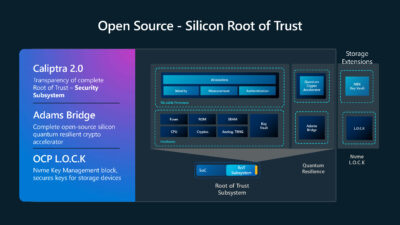
Now it would not matter that we don’t physically management the resource, because https://alertaone.ai/ so lengthy as the TPM is as safe as potential, we are in a position to have higher confidence that the layers we build on high of it even have a excessive degree of safety. Root of Belief (RoT) is a supply that can all the time be trusted within a cryptographic system. As A End Result Of cryptographic security relies on keys to encrypt and decrypt information and perform capabilities similar to producing digital signatures and verifying signatures, RoT schemes typically embody a hardened hardware module. A principal instance is the hardware security module (HSM) which generates and protects keys and performs cryptographic functions inside its secure environment.
Stage 3: Measured Boot And Distant Attestation
In a secure system, the RoT performs related functions, provisioning and storing the cryptographic root key. This secret is the premise for all secure operations, corresponding to local on-device asset safety for identification, authentication, and secure communication with the external environment. As such, the RoT should at all times be trusted by the system and is best applied as a Hardware Root of Trust (HRoT) for optimal safety. EnsoLab’s Hardware Root of Belief anchors device identification, safe boot and cryptographic key protection in hardware, establishing a trusted foundation for the security layers above. The PSA Root of Trust (PSA-RoT) was developed particularly for IoT and designed to help builders trying to cost-effectively implement IoT security, even on low value microcontrollers. It provides an easy-to-use safety element applied by many of the world’s leading chip distributors.
Functions

Whereas precise definitions can vary significantly, a RoT could be described as a set of implicitly trusted capabilities that the remainder of the system or device can use to make sure security; it is the basis on which a device maker can construct their “tower of trust”. As organizations transfer to improve their zero trust security posture, hopefully they understand that there must be nothing that’s trusted implicitly when it comes to interactions with their systems. Wherever possible, they need to search for the choice to confirm claims themselves, even when the claims seem to return from a trusted vendor or component.
- It’s the very first thing that executes when power is utilized, and its integrity determines whether anything that follows may be believed.
- Each safe system wants an anchor — a part that’s trusted unconditionally as a outcome of every little thing else’s trustworthiness is dependent upon it.
- Focus On integration of EnsoEntropy™, hardware trust and post-quantum expertise into products and silicon.
- The Boot ROM must be masks ROM — written throughout chip fabrication and physically inconceivable to switch.
- As A End Result Of cryptographic security depends on keys to encrypt and decrypt data and perform features similar to producing digital signatures and verifying signatures, RoT schemes usually embrace a hardened hardware module.
Hardware Security Modules
A TEE operating on a system with out Secure Boot offers no actual guarantee — the TEE firmware itself might be compromised. Safe Boot and not utilizing a hardware RoT means the verification keys could probably be tampered with. Strengthens safety in opposition to physical tampering, unauthorised entry and hardware-level assaults. A Root of Belief, commonly shortened to RoT, is the foundational safety part of a linked device.
TypingDNA Verify 2FA makes use of Root of Trust in this authentication context for its Normal integration. Before typing biometrics are used for verification, the organization verifies the person’s phone quantity or e mail handle because the Root of Trust. If typing verification fails or extra verification is required, Verify 2FA can fall back to an OTP despatched via that trusted channel.
His experience in both startups and enormous tech corporations has given him a ardour for shifting safety to the left and making it simpler to know and use. The implementations differ in ways in which matter the second you might be deciding what to belief.
The Core Idea: Keys That Can’t Go Away
Hardware root of trust might help with a range of safety issues which are primarily divided into pre-boot and post-boot. Pre-boot can use a pc chip known as a Trusted Platform Module (TPM) to verify/measure integrity and safe the boot course of from low-level malware. TPM assists with various activities throughout post-boot, including root of belief for authentication. Techniques that deploy hardware root of belief will use unified extensible firmware interface (UEFI), which provides options similar to “Secure Boot” that assist stop attacks or infection from malware.

Launch Your Vision With Us
Join CoderScotch to unlock tech possibilities! Collaborate on innovative projects, get expert support, and turn ideas into success with your trusted partner
Inquiry NowRecent Blogs

Descargar casino Zeus: pasos y métodos para jugar en Argentina
Nov 22, 2026
5 min
Cómo cargar dinero en Casino Zeus paso a paso – Guía completa para Argentina
Nov 22, 2026
6 min
Hackear casino Zeus: guía móvil para maximizar bonos y jugar seguro
Nov 22, 2026
6 min
Tags
Share Your Requirements!

Share:
Preferred source on