From Idea to Impact: A Practical Guide to Implementing AI in Healthcare
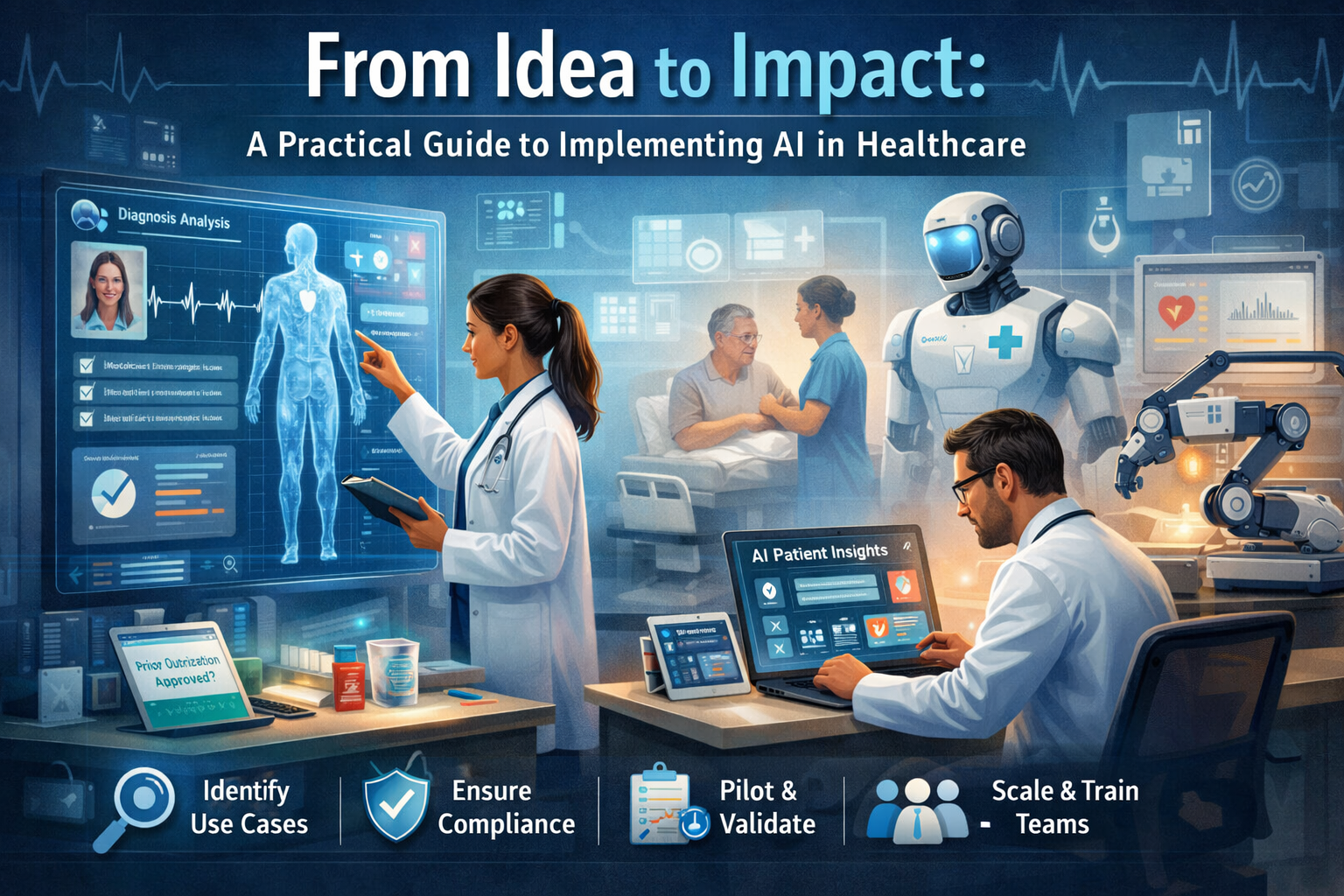
Artificial Intelligence is rapidly transforming healthcare but many organizations struggle to move from AI ideas to real, measurable impact. The challenge isn’t lack of interest; it’s execution, compliance, and integration with existing healthcare workflows.
This guide breaks down a practical, compliant, and results-driven approach to implementing AI in healthcare.
Step 1: Identify High-Impact Healthcare Use Cases
Successful healthcare AI starts with real clinical or operational pain points, not buzzwords.
High-Value AI Use Cases in Healthcare
- Patient appointment scheduling & reminders
- AI-powered triage and symptom pre-assessment
- Clinical documentation automation (SOAP notes, summaries)
- Medical billing & coding assistance
- Prior authorization and insurance verification
- Caregiver training & compliance monitoring
- Patient engagement via chatbots (web, app, WhatsApp)
👉 Rule of thumb: If the task is repetitive, time-consuming, or data-heavy, AI can help.
Step 2: Ensure Data Readiness & Compliance
Healthcare AI lives or dies by data quality and regulatory compliance.
Key Considerations
- Structured vs unstructured data (EHRs, PDFs, notes)
- Data privacy (HIPAA, GDPR, local healthcare regulations)
- Role-based access control
- Audit logs and traceability
Best Practices
- Use de-identified or anonymized data for AI training
- Apply least-privilege access for staff and systems
- Avoid storing sensitive patient data inside AI models
AI must support compliance not introduce new risks.
Thinking about using AI in your healthcare organization but not sure where to start?
Book a Free Healthcare AI Consultation
We’ll help you identify high-impact use cases, define a compliant AI roadmap, and estimate cost & timelines no technical jargon, no obligation.
Step 3: Choose the Right AI Implementation Partner
Healthcare AI is not a plug-and-play SaaS tool. It requires domain expertise, compliance awareness, and real-world execution.
What to Look for in an AI Partner
- Proven healthcare workflow experience
- HIPAA-compliant system design
- Integration with EMRs, CRMs, and billing systems
- Clear audit logs and explainability
- MVP-first approach (pilot → validate → scale)
Avoid vendors who sell generic AI demos without healthcare context.
Step 4: Build a Pilot (MVP) Before Full Rollout
Start small. Prove value. Then scale.
Example Healthcare AI MVPs
- AI assistant for patient FAQs and appointment status
- Automated intake form analysis and summarization
- Caregiver training chatbot with compliance tracking
- Internal AI for claims or eligibility verification
Measure Early Success By
- Reduced admin workload
- Faster patient response times
- Lower operational costs
- Improved patient satisfaction
A focused MVP in 4–6 weeks is often enough to validate ROI.
Step 5: Integrate AI into Daily Clinical & Admin Workflows
AI should blend into existing workflows, not disrupt them.
Smart Integration Points
- Patient portals & mobile apps
- WhatsApp or SMS patient communication
- Admin dashboards
- EMR, CRM, and billing systems
The best healthcare AI feels invisible it simply makes work easier.
Final Thoughts
AI in healthcare is a long-term capability, not a one-time project.
When done right, AI helps:
- Reduce staff burnout
- Improve patient experience
- Lower operational costs
- Enable faster, smarter decisions
The key is starting with the right use case, the right partner, and a compliance-first mindset.